Retinoid Purging vs Breakout: How to Tell the Difference
By Tutiba Education Team
Medically reviewed by Dr. Aya Elbrashy
Skin & Beauty Nutrition Specialist with 10+ years of experience, teaching an evidence-based curriculum.
Last reviewed November 5, 2026
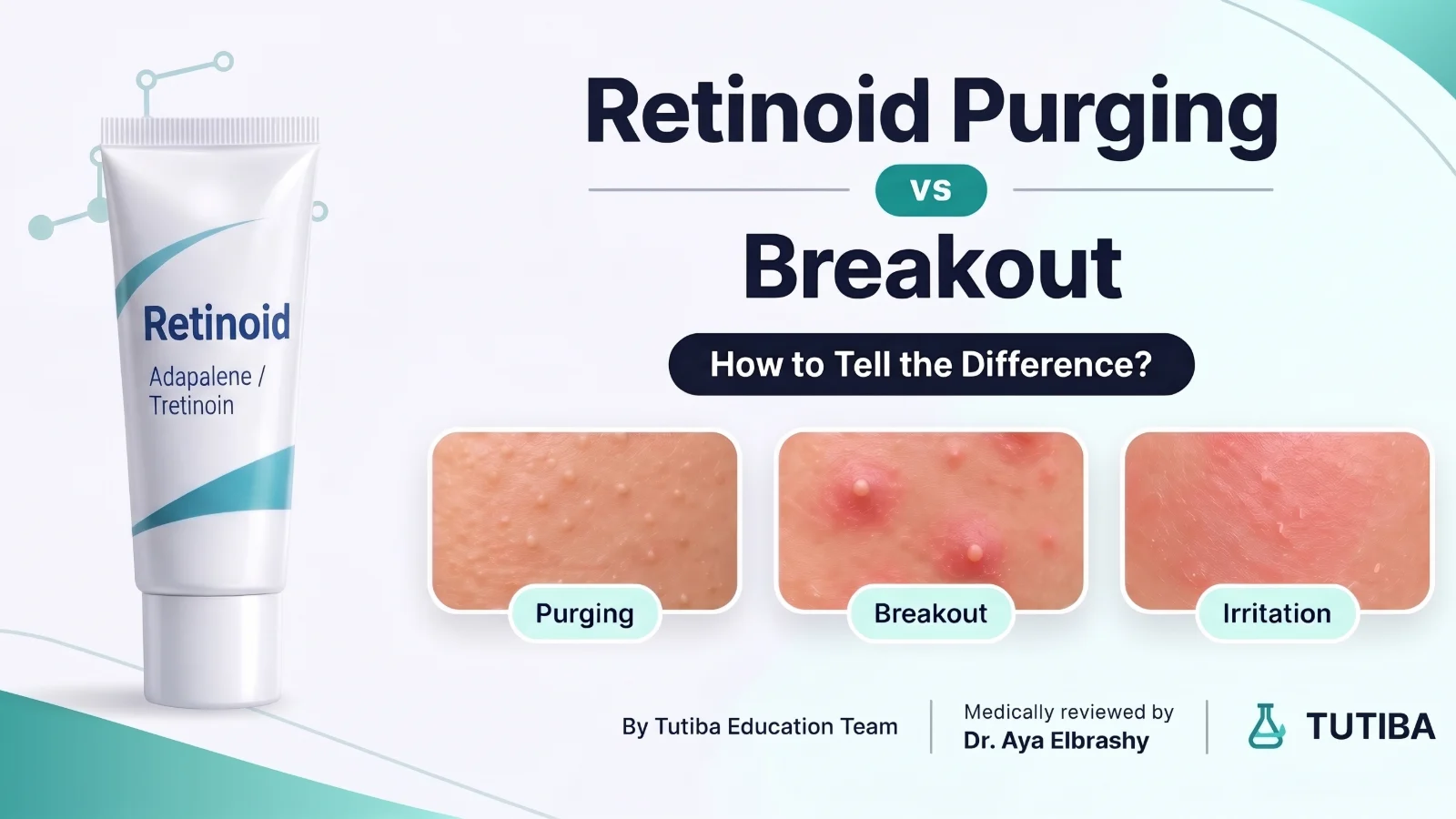
Retinoid purging is an early flare the adapalene and tretinoin labels describe; a breakout comes from another trigger, such as a pore-clogging or irritating product.
Retinoid purging is the flare of acne that may occur in the early weeks after starting a topical retinoid such as adapalene or tretinoin. The adapalene label calls it an "apparent exacerbation" due to the drug's action on "previously unseen lesions"; the tretinoin microsphere label describes the same early worsening for inflammatory lesions. A breakout is new acne with another trigger, such as a product that clogs pores or irritates the skin, and it is not part of the retinoid's expected course.
So retinoid purging vs breakout comes down to three things you can ask any client: which product did they start, where are the new spots, and is the skin improving over the weeks the label gives for a response?
What the labels actually say about purging
"Purging" is the word clients use; the labels say "apparent exacerbation" and "initial worsening". The regulatory wording is more precise, and quoting it to clients sets the right expectation.
The FDA label for adapalene gel 0.1 % states: "During the early weeks of therapy, an apparent exacerbation of acne may occur. This is due to the action of the medication on previously unseen lesions and should not be considered a reason to discontinue therapy." The same label expects therapeutic results after eight to twelve weeks of treatment.
The 2025 label for tretinoin microsphere gel (0.04 % to 0.1 %) says an apparent exacerbation of inflammatory acne lesions may occur in the early weeks and, if the gel is tolerated, this initial worsening "should not be considered a reason to discontinue therapy" (FDA label).
Three details matter for counselling:
The labels say "may occur". Not everyone flares.
Neither label gives a number of weeks for the flare. They say "early weeks", so any precise "purge lasts X weeks" figure you see online has no label support.
The tretinoin label adds a condition: "if tolerated". A flare is acceptable; severe irritation is not.
These statements come from the prescription labels for adapalene and tretinoin. The adapalene label quoted is the 2007 version, which notes it may not be the latest approved; check the status and leaflet of the product in front of you where you practice. We found no comparable label or trial data for cosmetic retinol, so be cautious about promising the same pattern with retinol serums.
Why a retinoid can make acne look worse first
Retinoids work inside the follicle. A review in the Journal of Cutaneous Medicine and Surgery explains that retinoids "normalize abnormal desquamation in acne by increasing follicular epithelial turnover, leading to the expulsion of mature comedones and the suppression of microcomedone formation."
Comedones that were already building get pushed to the surface sooner, which is our reading of the adapalene label's "previously unseen lesions". Over time, fewer new microcomedones form, and the acne settles.
That mechanism gives you a practical rule, though it is our reasoning rather than a tested criterion: a true purge should come from a product that speeds turnover inside the follicle, and it should show up where the person already gets acne, because those are the follicles with lesions in progress. No study has validated location as a diagnostic test, so treat it as a clue, not proof.
Purging vs breakout: how to tell them apart
No single row settles it; look at the pattern.
Question | Points to purging | Points to a breakout or another cause |
|---|---|---|
What did they start? | A topical retinoid (adapalene, tretinoin) | A new moisturizer, makeup, sunscreen, hair oil, or several new products at once |
Where are the spots? | Their usual acne areas (our reasoning, see above) | New areas, such as only the forehead and temples after a new hair oil |
What is the trend? | Improving within the response window on the label | Not improving while the product is still used |
What else is happening? | Some dryness or peeling that eases with continued use | Marked burning, swelling, blistering, or a rash beyond the treated area |
Routine changes | One product added | Products swapped every few days, scrubbing, harsh cleansers |
The American Academy of Dermatology warns that "Using a different product every few days can also irritate your skin, causing new breakouts" and that scrubbing irritates acne-prone skin and worsens acne. A client who started a retinoid and three other products in the same week cannot be sure which one is responsible.
Products that cause breakouts
For skin care, the AAD suggests labels such as "non-comedogenic", "won't clog pores", "non-acnegenic" or "oil free", while noting that some of these products may still cause acne in a few people. In its tips for acne in darker skin tones, the AAD says that for acne only on the forehead and temples "your hair oil may be the cause" and suggests a hair product that contains water or glycerin instead of oil. The same page advises against cocoa butter and shea butter on the face, back or chest.
Irritation: the third thing that looks like a flare
Some apparent "purges" may be retinoid irritation, which the labels place in the same early weeks. The adapalene label lists erythema, dryness, scaling, burning and pruritus, which are "most likely to occur during the first two to four weeks and will usually lessen with continued use." In two vehicle-controlled trials of tretinoin microsphere gel 0.1 % (347 participants, 12 weeks), participants on the gel had higher irritation scores than those on vehicle for redness, peeling, dryness, burning/stinging or itching; the scores peaked during the first two weeks and decreased thereafter.
Itching is on the expected list for adapalene, so itch alone does not tell you whether it is irritation or something else. Severity, location and trend tell you more. The tretinoin label reports that 6 % (14 of 224) of participants on the 0.1 % gel stopped because of irritation, and four of them had severe irritation after 3 to 5 days, one with blistering.
What the labels advise:
Adapalene: depending on severity, reduce the frequency of application or stop, and stop if a reaction suggesting sensitivity or chemical irritation occurs.
Tretinoin microsphere: wash gently with a mild, non-medicated soap, avoid washing too often or scrubbing hard, and apply a moisturizer. If severe irritation occurs, stop temporarily or permanently.
Adapalene should not go on cuts, abrasions, eczematous or sunburned skin; the tretinoin label also says to avoid eczematous skin and to wait until sunburn fully recovers.
One caveat on less frequent use: the tretinoin label states that efficacy at reduced frequencies of application has not been established. The adapalene label allows reducing frequency for irritation, but for tretinoin a client who cuts back should not assume the label's response timeline still applies.
A review of retinoids in skin of colour adds that "For patients with sensitive skin, applying moisturizer before the retinoid may help reduce irritation."
A counselling flow for "my skin got worse"
Step 1: Ask what changed and when
Which products are new, the date each one started, and whether anything else changed (cleanser, scrub, makeup, hair products). If more than one product started together, you cannot attribute the flare to the retinoid with confidence.
Step 2: Look at where and what
Check whether the new lesions are in their usual acne zones or somewhere new, and whether there is redness, scaling or burning on the skin between spots. Acne only on the forehead and temples points you toward hair products (AAD).
Step 3: Check for warning signs
Blistering, swelling, severe burning, or a rash spreading past the treated area is not purging. Advise stopping the product and referring (see the last section).
Step 4: Decide
Retinoid started alone, usual areas, tolerable dryness: likely the initial worsening the label describes. Advise continuing, as the labels do, with a gentle cleanser and moisturizer.
New non-retinoid product, new areas, no improvement: likely a product breakout. Stop the suspect product.
Significant redness, burning or peeling: irritation. Follow the product's label: for adapalene, reduce how often it is applied or stop, depending on severity; for tretinoin microsphere gel, wash gently, moisturize, and stop temporarily or permanently if irritation is severe. Use sun protection with either.
Step 5: Set a review date
Agree when you will reassess, using the timelines in the next section, so the client does not abandon the retinoid in week three.
Worked examples
Example: A 19-year-old started adapalene 0.1 % gel nightly two weeks ago and reports more spots on the chin and cheeks, where they always break out, with mild flaking. Nothing else changed, and they are not pregnant, planning pregnancy or breastfeeding. This fits the label's early-weeks exacerbation plus expected dryness. Advise continuing, adding a moisturizer and daily sunscreen, and review at about eight weeks.
Example: A client switched to a rich new face cream and a hair oil last month and now has small bumps along the forehead and temples, an area that was clear before. They are not using a retinoid. This is not purging. Suggest stopping the hair oil and choosing a non-comedogenic moisturizer, then reassess.
What to expect and when
Timepoint | What the sources say |
|---|---|
First 2 weeks | Tretinoin microsphere gel: irritation peaked in the first two weeks in trials of the 0.1 % gel; improvement may be noticed after two weeks |
First 2 to 4 weeks | Adapalene gel 0.1 %: redness, dryness, scaling, burning or itching most likely, usually lessening with continued use |
At least 4 weeks | AAD: give an acne treatment at least 4 weeks; some improvement in 4 to 6 weeks if it works |
More than 7 weeks | Tretinoin microsphere gel: may be needed for sustained benefit |
8 to 12 weeks | Adapalene gel 0.1 %: therapeutic results should be noticed |
12 weeks or longer | DermNet: improvement may take this long |
The AAD adds that clearing "can take two to three months or longer". If the skin is no better, or worse, by the end of the response window on the label, the flare is no longer explained by purging and the plan needs review. This cut-off is our practical judgement based on those timelines; no study has defined when a purge officially ends.
Pregnancy, breastfeeding, sun and skin of colour
Pregnancy
Ask before recommending any retinoid. A clinician's review states that "Topical retinoids are recommended to be avoided during pregnancy," and describes them as contraindicated or advised against for women who are pregnant or planning to become pregnant. DermNet notes that some topical retinoids are contraindicated in pregnancy. The adapalene label says it should be used in pregnancy only if the potential benefit justifies the potential risk to the fetus. The 2025 tretinoin microsphere label says observational studies have not established a drug-associated risk of major birth defects, but notes those studies have methodological limitations such as small samples. Refer pregnant clients, or those planning pregnancy, to their doctor for acne treatment.
Breastfeeding
As a general rule, topical retinoids should be avoided during breastfeeding unless prescribed by a physician. While the adapalene label merely advises caution (as milk excretion is unknown), and the tretinoin label restricts use to the smallest area and shortest time (strictly avoiding the breast area), the safest baseline is avoidance. Always refer breastfeeding clients to their doctor before any retinoid is started.
Sun
Topical retinoids can cause photosensitivity. The adapalene label advises minimizing sun exposure, including sunlamps, using sunscreen and protective clothing when exposure cannot be avoided, and notes that wind or cold may also irritate. The tretinoin label recommends daily sunscreen of SPF 15 or higher plus protective clothing when sun exposure cannot be avoided, and not using the gel on sunburned skin until it recovers.
Skin of colour
The Callender review notes that hyperpigmentation from acne may be more distressing than the acne itself for patients with skin of colour, and that retinoid irritation can itself contribute to unwanted pigmentary changes. For these clients, keeping irritation low matters twice over. The review suggests moisturizer before the retinoid for sensitive skin, applying the retinoid as prescribed and using sunscreen; the adapalene label adds caution with other irritating products.
Combinations
The adapalene label urges caution with medicated or abrasive cleansers and strongly drying products, and particular caution with sulfur, resorcinol or salicylic acid preparations; if these have been used, it advises waiting until their effects on the skin have subsided before starting adapalene. Retinoids and benzoyl peroxide can both be irritating and drying, and a combination product "can amplify this side effect." A routine that pairs a retinoid with benzoyl peroxide still needs the retinoid pregnancy warning above.
When to refer
The labels say when to stop a retinoid, not when to refer. The two AAD points below are sourced; the rest are our practical judgement from the label warnings, because blistering, swelling or a spreading rash can signal a sensitivity reaction rather than expected irritation.
Blistering, swelling, severe burning, or a rash that spreads beyond the treated area.
Deep, painful lesions: the AAD advises seeing a dermatologist for cysts and nodules, which can leave scars.
Acne that has not cleared with treatment bought without a prescription.
No improvement by the end of the label's response window despite correct daily use.
Pregnancy, planned pregnancy or breastfeeding, before any retinoid is started.
Any client who needs tretinoin, which is prescription-only: refer to a doctor.
Vitamin A derivatives and their therapeutic role for skin are covered in the Skin and Hair Care Diploma Part 1 (vitamin A section).
How long does retinoid purging last?
The adapalene and tretinoin labels only say a flare may occur in the early weeks and give no exact length. Results should be noticed after eight to twelve weeks with adapalene gel 0.1 %, and tretinoin microsphere gel may need more than seven weeks for sustained benefit. In our judgement, a flare that is not improving by then needs review.
Can a moisturiser or sunscreen cause purging?
The labelled initial worsening comes from retinoid labels, and retinoids act by speeding cell turnover in the follicle. In our judgement, new spots after a moisturiser, sunscreen, makeup or hair oil are more likely a breakout from that product, so stopping it is a sensible first step.
Should I stop adapalene if my acne gets worse?
The label says an early apparent worsening should not be considered a reason to stop. It says to reduce how often you apply it, or stop, depending on how severe the irritation is, and to stop if a reaction suggesting sensitivity or chemical irritation occurs; in our judgement, blistering or swelling means stop and see a doctor.
Is itching a sign of a breakout rather than purging?
Not on its own. The adapalene label lists itching among the expected irritation signs in the first two to four weeks, so judge by severity, location and trend instead.
Can I use a retinoid while pregnant?
Topical retinoids are generally advised against in pregnancy and when planning one. A pregnant client should ask their doctor about acne treatment instead.
Learn more: acne types, treatment approaches and the topical agents used for acne are taught in the Skin and Hair Care Diploma Part 2.
Sources
- 1.FDA prescribing information: Differin (adapalene) Gel 0.1% — accessdata.fda.gov, accessed 2026-11-05
- 2.FDA prescribing information: Retin-A Micro (tretinoin) gel — accessdata.fda.gov, accessed 2026-11-05
- 3.Motamedi M et al. A Clinician's Guide to Topical Retinoids. J Cutan Med Surg (PMC) — pmc.ncbi.nlm.nih.gov, accessed 2026-11-05
- 4.Callender VD et al. Topical Retinoids, Acne and Post-inflammatory Hyperpigmentation in Skin of Color. Am J Clin Dermatol (PMC) — pmc.ncbi.nlm.nih.gov, accessed 2026-11-05
- 5.DermNet: Topical retinoids — dermnetnz.org, accessed 2026-11-05
- 6.American Academy of Dermatology: 9 things to try when acne won't clear — aad.org, accessed 2026-11-05
- 7.American Academy of Dermatology: 10 tips for clearing acne in darker skin tones — aad.org, accessed 2026-11-05