Benzoyl Peroxide Wash vs Leave-On: Which to Recommend
By Tutiba Education Team
Medically reviewed by Dr. Aya Elbrashy
Skin & Beauty Nutrition Specialist with 10+ years of experience, teaching an evidence-based curriculum.
Last reviewed November 5, 2026
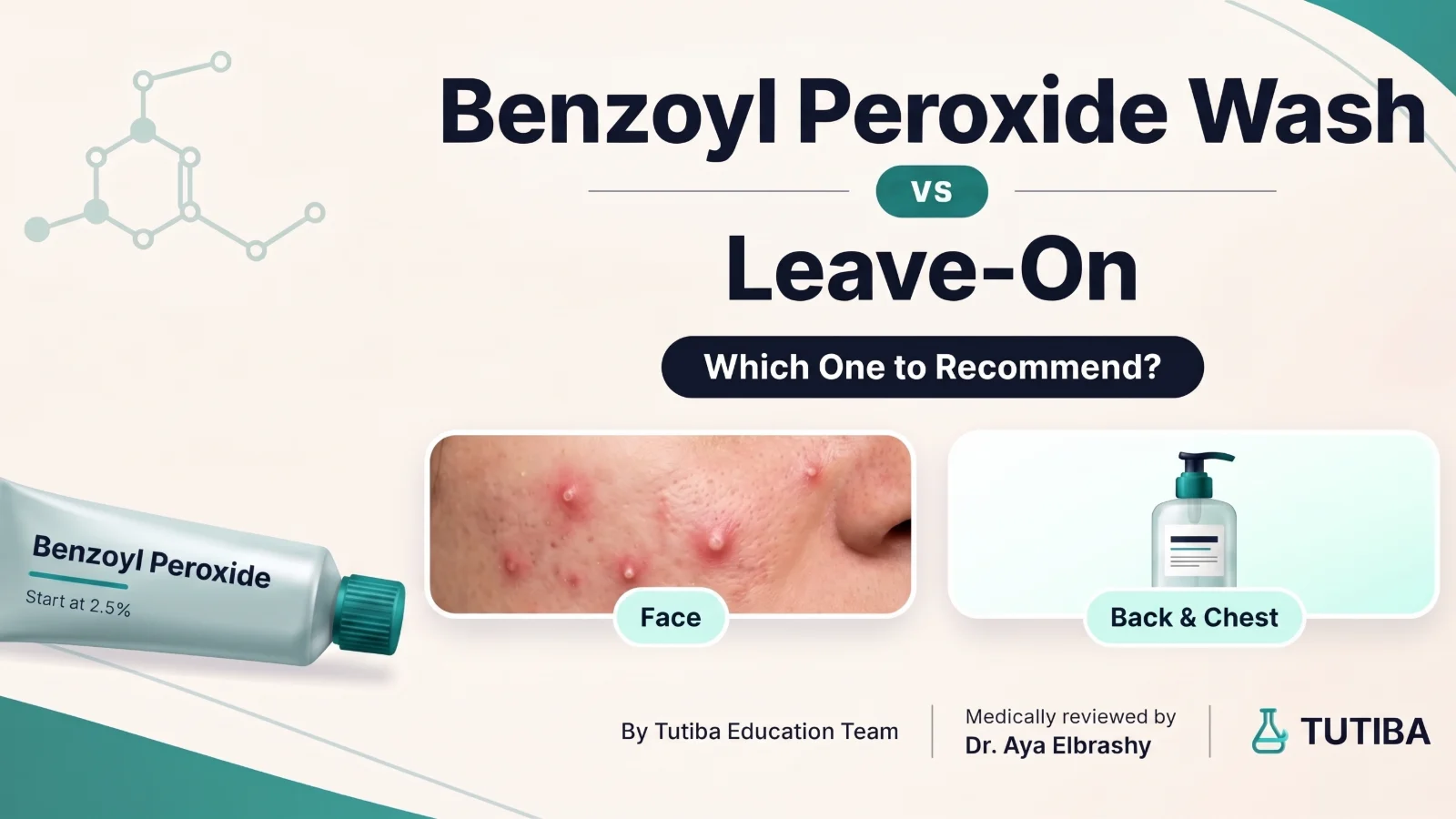
A leave-on benzoyl peroxide gel has the most trial evidence. A rinse-off wash suits the back and chest and spares towels from bleaching; on the back, the AAD advises leaving it on for two to five minutes.
For the benzoyl peroxide wash vs leave-on choice, a leave-on gel is the better-studied option: of the 120 trials in the 2020 Cochrane review, 92 used a gel and only six tested a wash-off product. No source here compares the two formats head to head on acne lesions.
A wash is the practical choice for the back or chest and when bleached towels are a complaint, because it is rinsed off, which prevents bleached clothes, sheets and towels. It also suits skin that acne products have irritated before, as long as it is not very sensitive: a 2025 review found wash-off products better tolerated in patients 12 years and older. On the back, the AAD advises leaving it on for two to five minutes before rinsing.
A higher strength added no efficacy in the one comparison here: in three double-blind studies reported in one 1986 paper, a 2.5 % gel was equivalent to 5 % and 10 % in reducing inflammatory spots.
What the evidence shows for each format
Leave-on gels and creams
Most of the trial evidence for benzoyl peroxide comes from leave-on products. The Cochrane review, pooling all formulations, concluded that benzoyl peroxide "may be more effective than placebo or no treatment for improving acne", a finding it rated as low-certainty evidence. Gel was the vehicle in 92 of its 120 trials.
Washes and cleansers
The evidence that the brief contact of a wash is enough comes from small studies, some of them company data on file, summarized in a 2008 review of benzoyl peroxide cleansers:
On a laboratory human skin model, 20 seconds of contact with the vehicle of a 10 % cleanser, followed by up to three 10-second rinses, still left benzoyl peroxide deposited in the epidermis.
A 10 % cleanser used twice daily reduced acne bacteria (P. acnes) by 93.5 % at day 5 in 17 people.
In a 12-week investigator-blinded study, adding a 6 % cleanser to tretinoin 0.1 % microsphere gel (a prescription retinoid) reduced inflammatory lesions by 58.5 %, against 29.8 % with the retinoid alone, and facial irritation was not increased overall. Tretinoin, like other topical retinoids, is generally avoided in pregnancy.
The same review states that there are "too few studies, and a lack of comparative studies among formulations".
Why contact time matters
One small open-label study of 20 healthy adults, on the back, points the other way; the review reporting it is by an author with industry disclosures. A 5.3 % emollient foam left on the skin cut P. acnes counts by 1.93 log after one week, while an 8 % wash produced no reduction after two weeks. The investigator suggested the brief contact with the wash may not have been enough. In a six-patient pilot, the same foam washed off after five minutes still gave a significant 0.6 log reduction after eight daily treatments.
These are bacterial counts, not acne lesions, and none of the sources reviewed here reports a trial comparing a wash with a leave-on product on lesion counts. The practical reading is that a wash can work, and contact time is the part the client controls.
Which strength to choose
The US over-the-counter monograph allows benzoyl peroxide from 2.5 to 10 %, and DermNet lists creams, gels, lotions and washes at 2.5 %, 5 % and 10 %. For red, inflamed spots, the only strength comparison in these sources is one 1986 paper of gels. In its three double-blind studies of 153 patients with mild to moderately severe acne (Mills and colleagues), a 2.5 % gel was equivalent to 5 % and 10 % in reducing papules and pustules. Peeling, redness and burning with the 2.5 % gel were less frequent than with the 10 % preparation and equivalent to the 5 % gel.
In its advice for darker skin tones, the AAD recommends starting with 2.5 % to prevent irritation, because stronger products "can cause dryness and flaking, which can worsen acne". For the back, it describes a 5.3 % foaming wash as less likely to cause irritation, dryness or peeling, and 10 % as the strongest concentration sold without a prescription. A 2025 review adds that lower-concentration and wash-off products are better tolerated in patients 12 years and older.
Decision table: wash or leave-on
Client situation | Choose | Why |
|---|---|---|
Facial acne, first benzoyl peroxide, no history of reacting to acne products | Leave-on 2.5 % gel, thin layer over the whole affected area, once daily at first | Most trial evidence is for leave-on gels; in one 1986 paper a 2.5 % gel matched 5 % and 10 % on inflammatory lesions and irritated less than 10 % |
Irritated by acne products before, but not very sensitive skin | 2.5 % leave-on every other day, or a wash | The AAD, in its advice for darker skin tones, suggests every other day if 2.5 % irritates; a 2025 review found wash-off and lower-strength products better tolerated in patients 12 years and older |
Very sensitive skin, or known sensitivity to benzoyl peroxide | Do not recommend benzoyl peroxide in either format; refer to a doctor for alternatives | The US label says do not use if you have very sensitive skin or are sensitive to benzoyl peroxide. Referring is practical judgement, because the other acne options a doctor can weigh are outside this article |
Back, chest or shoulders | Foaming wash left on for 2 to 5 minutes, then rinsed | The AAD says it works best left on the back for two to five minutes, based on small foam studies; using the same timing on the chest and shoulders is practical judgement. Rinsing prevents bleached clothes, sheets and towels |
Bleached pillowcases or towels are already a complaint | A wash, or a leave-on product only once it has fully dried | DermNet: let it dry completely before skin touches fabric; cotton and linen stain more readily than polyester and fleece |
Prescribed a topical or oral antibiotic by a doctor | Add benzoyl peroxide in either format | DermNet: it may reduce the growth of antibiotic-resistant bacteria; a 6 % cleanser markedly reduced resistant strains in one 30-person study |
Already using adapalene | Either format; a morning wash with adapalene at night is a practical split | The AAD says adapalene with benzoyl peroxide can improve results. Splitting them is practical judgement to space two irritants; no study here compared schedules. Adapalene is avoided in pregnancy |
Pregnant | Benzoyl peroxide in either format, without a retinoid | ACOG (via MotherToBaby) says benzoyl peroxide may be used in pregnancy if needed; topical retinoids such as adapalene and tretinoin are generally avoided |
Breastfeeding | Either format, never on the nipple or areola | MotherToBaby: wash a product off the breast or chest area before feeding |
Example: a 17-year-old has papules on the forehead and cheeks and has never used an acne product. A 2.5 % leave-on gel at night over the whole forehead and both cheeks, once daily at first, is a reasonable start. In the 1986 gel studies, 2.5 % matched 5 % and 10 % on papules and pustules and irritated less than 10 %. Remind them to use sunscreen in the morning, as the label advises.
Example: a 25-year-old with spots across the upper back has ruined two towels with a gel. A 5.3 % foaming wash in the shower, left on for two to five minutes and then rinsed, treats the area and protects the towels.
The acne section of Skin and Hair Care Diploma Part 2 places these choices inside a full acne plan, alongside cleansers, exfoliants and topical antibiotics.
How to use each format properly
A wash
Wet the skin and lather a small amount over the whole affected area, not only the visible spots; this borrows the US label direction for leave-on use ("cover the entire affected area with a thin layer") as practical judgement.
Leave it on before rinsing. The AAD's two-to-five-minute advice is for the back and rests on small foam studies. Using the same habit on the face is practical judgement: it adds the contact time the 8 % wash study suggests is the weak point, though none of the sources reviewed here tested timing on the face.
Rinse well and pat dry. Keep it off the hair and coloured towels: the US label warns that hair and dyed fabrics may be bleached.
Store the tube outside the hot shower. A 2025 review reports that the FDA found benzene, which forms when benzoyl peroxide breaks down with heat, in a number of products in March 2025, leading to voluntary recalls; more than 90 % of tested products had undetectable or extremely low levels. The authors advise moving products to a cooler place while showering and keeping them out of direct sunlight.
A leave-on gel or cream
Clean and dry the skin, then cover the entire affected area with a thin layer.
Start once daily and increase gradually, as the US label directs (up to one to three times daily). DermNet suggests starting every second night and building up to once or twice daily as tolerated.
For a first-time user, the label offers a sensitivity test: apply sparingly to one or two small affected areas during the first 3 days.
Let it dry fully before the skin touches clothes, towels or bedding.
Avoid unnecessary sun exposure and use a sunscreen.
Counselling: questions to ask and mistakes to correct
Five questions before you recommend
Where is the acne: face, back, chest, or all three?
Has any acne product burned, stung or peeled your skin before?
What else are you using: adapalene, salicylic acid, an antibiotic from your doctor?
Are you pregnant, trying to conceive or breastfeeding?
Do you have darker skin that marks easily after spots?
Common mistakes, each with a one-line correction
Rinsing the wash straight off. "Leave the lather on for two to five minutes, then rinse."
Dabbing only on spots. "Spread a thin layer over the whole area where spots appear, not just the spots you can see."
Buying 10 % to work faster. "In three trials of gels, 2.5 % reduced red spots as well as 10 % and irritated less."
Stopping after two weeks. "It can take several months to see an improvement, so keep going."
Stacking drying products. "Using another acne product at the same time makes dryness and irritation more likely."
Skin of colour
The AAD notes that in people with skin of colour, acne "is often accompanied by dark spots or patches called hyperpigmentation", and that even at-home acne treatments can cause "permanent dark marks". Irritation control is the priority here: start at 2.5 %, use it every other day if it stings, or choose a wash. One worry you can settle: the AAD calls the idea that benzoyl peroxide causes light spots on the skin a myth.
Safety and when to refer
Dryness and mild irritation are expected; the Cochrane review lists dryness, irritation, dermatitis, redness, application-site pain and itching as the most common effects, mostly mild to moderate. The label notes irritation may be reduced by using the product less often or at a lower concentration. Refer when you see any of these:
Severe irritation. The US label says to stop use and ask a doctor if irritation becomes severe.
An itchy rash with redness and dryness that does not settle. DermNet notes contact dermatitis can be due to irritation or allergy; a doctor can tell them apart.
Swelling of the face or lips, hives, or difficulty breathing. DermNet reports that serious allergic reactions, including anaphylaxis, are rare but have occurred. Stop the product and get urgent care, because anaphylaxis is an emergency.
Deep, painful nodules or cysts, scarring, or little change after several months. This is practical judgement: these need a doctor because the next steps (topical or oral antibiotics, prescription retinoids) are prescription-only.
Frequently asked questions
Does a benzoyl peroxide wash work if I rinse it off straight away?
A laboratory skin-model test found some benzoyl peroxide stays in the skin after 20 seconds of contact and rinsing, but a small study on the backs of 20 healthy adults found an 8 % wash did not reduce acne bacteria after two weeks. Leaving the lather on for two to five minutes, as the AAD advises for the back, adds contact time.
Is a wash or a leave-on product better for back acne?
No study in these sources compared the two formats on back acne lesions. The AAD advises a foaming benzoyl peroxide wash left on the back for two to five minutes and then rinsed, which prevents bleached clothes, sheets and towels. In one small study of bacterial counts on the back, a 5.3 % foam left on reduced bacteria while an 8 % wash did not, and the investigator suggested the wash's brief contact time may not have been enough.
Can I use a benzoyl peroxide wash with adapalene?
Yes, the AAD says using adapalene along with benzoyl peroxide can improve results. Dryness and irritation are more likely when two acne products are used at the same time, and avoid adapalene during pregnancy.
Will benzoyl peroxide bleach my towels and pillowcases?
It can bleach clothing, sheets, pillowcases, towels, hair and dyed fabrics. Let a leave-on product dry completely before it touches fabric, and note that cotton and linen stain more readily than polyester and fleece.
Is benzoyl peroxide safe during pregnancy and breastfeeding?
ACOG says benzoyl peroxide products may be used during pregnancy if needed. During breastfeeding it has not been well studied, but the amount reaching breast milk is likely to be low; keep it off the nipple and areola and wash it off the chest before feeding.
Learn more: Skin and Hair Care Diploma Part 2 covers acne types, cleansers, topical and oral antibiotics, and isotretinoin.
Sources
- 1.Mills OH et al. Comparing 2.5%, 5%, and 10% benzoyl peroxide on inflammatory acne vulgaris. Int J Dermatol 1986 (abstract, Europe PMC) — ebi.ac.uk, accessed 2026-11-05
- 2.What is the role of benzoyl peroxide cleansers in acne management? J Clin Aesthet Dermatol 2008 (PMC) — pmc.ncbi.nlm.nih.gov, accessed 2026-11-05
- 3.Bikowski J. Benzoyl peroxide (5.3%) emollient foam in truncal acne vulgaris: a review. J Clin Aesthet Dermatol 2010 (PMC) — pmc.ncbi.nlm.nih.gov, accessed 2026-11-05
- 4.Yang Z et al. Topical benzoyl peroxide for acne. Cochrane Database of Systematic Reviews 2020 (PMC) — pmc.ncbi.nlm.nih.gov, accessed 2026-11-05
- 5.Czyz S et al. Benzoyl peroxide in the treatment of acne: are there potential health concerns? Front Pediatr 2025 (PMC) — pmc.ncbi.nlm.nih.gov, accessed 2026-11-05
- 6.DermNet: Benzoyl peroxide — dermnetnz.org, accessed 2026-11-05
- 7.American Academy of Dermatology: Back acne, how to see clearer skin — aad.org, accessed 2026-11-05
- 8.American Academy of Dermatology: 10 tips for clearing acne in darker skin tones — aad.org, accessed 2026-11-05
- 9.US FDA OTC topical acne monograph, labeling: 21 CFR 333.350 (Cornell LII) — law.cornell.edu, accessed 2026-11-05
- 10.US FDA OTC topical acne monograph, active ingredients: 21 CFR 333.310 (Cornell LII) — law.cornell.edu, accessed 2026-11-05
- 11.US FDA prescribing information: Retin-A Micro (tretinoin) gel, 2025 label — accessdata.fda.gov, accessed 2026-11-05
- 12.MotherToBaby: Topical acne treatments fact sheet — mothertobaby.org, accessed 2026-11-05